



Insights Discovery is one of the most widely adopted psychometric tools in the corporate world. Used by more than a million people every year across 40 countries, it gives professionals a memorable framework for understanding how people think, communicate, and work together, built around four color energies rooted in the psychology of Carl Gustav Jung.
Coaches, HR professionals, consultants, and team leaders use it to open conversations that would otherwise take months to reach. Some pair it with deeper measurement tools like MindSonar to work with greater precision in specific organizational contexts. This guide covers both the strengths and the real limits of Insights Discovery, so you can make an informed decision about when and how to use it.
In this article
What is Insights Discovery?
Insights Discovery is a psychometric assessment tool developed by Andi Lothian and his son Andy Lothian through Insights Learning and Development, based in Scotland. It translates Carl Gustav Jung’s theory of psychological types into a four-color framework that is visual, practical, and immediately accessible to professionals at any level of an organization.
Rather than producing a complex report with dozens of subscales, Insights Discovery gives people a language they can actually remember and use. Ask someone their Insights color six months after a workshop and they will almost certainly recall it. That memorability is a deliberate design choice, and it is a large part of why organizations like LinkedIn, 3M, and Indeed have embedded it into their development programs at scale.
The tool generates a personal profile of more than 20 pages describing how a person prefers to think, communicate, and interact with others, along with a position on the Insights Discovery wheel that shows the relationship between their four color energies in a single visual. Practitioners who want to go beyond general preferences and understand how someone actually thinks within a specific coaching or work context often use Insights Discovery as a starting point before applying more contextual tools.

History and origin: from Jung to the color wheel
Carl Gustav Jung published his theory of psychological types in 1921. He proposed that people differ in two fundamental ways: in how they prefer to direct their energy (toward the outer world or the inner world) and in how they prefer to take in information and make decisions. These differences, Jung argued, produce recognizable patterns that can be observed and understood.
Andi Lothian spent years studying this work and saw a practical problem: Jung’s framework was deep and rigorous, but almost entirely inaccessible to people without a background in psychology. In the early 1990s, he and his son Andy set out to change that. The four-color wheel they developed was the result: a visual, intuitive representation of the same underlying Jungian dimensions, designed to be understood in minutes rather than studied over years.
What Lothian built was not a simplification of Jung’s work so much as a translation of it. The theoretical foundations remain intact. What changed was the language used to express them. That decision, to prioritize accessibility without sacrificing depth, is what gave Insights Discovery its staying power in organizational settings where complex psychology reports rarely get read.
The four color energies in depth
Every person has all four color energies available to them. The assessment does not assign you a single color. It shows you the relative strength of each energy in your profile, and which one or two tend to lead in most situations. Understanding this, both in yourself and in the people you work with, is the practical foundation of everything Insights Discovery enables.
Fiery Red — Competitive and results-driven
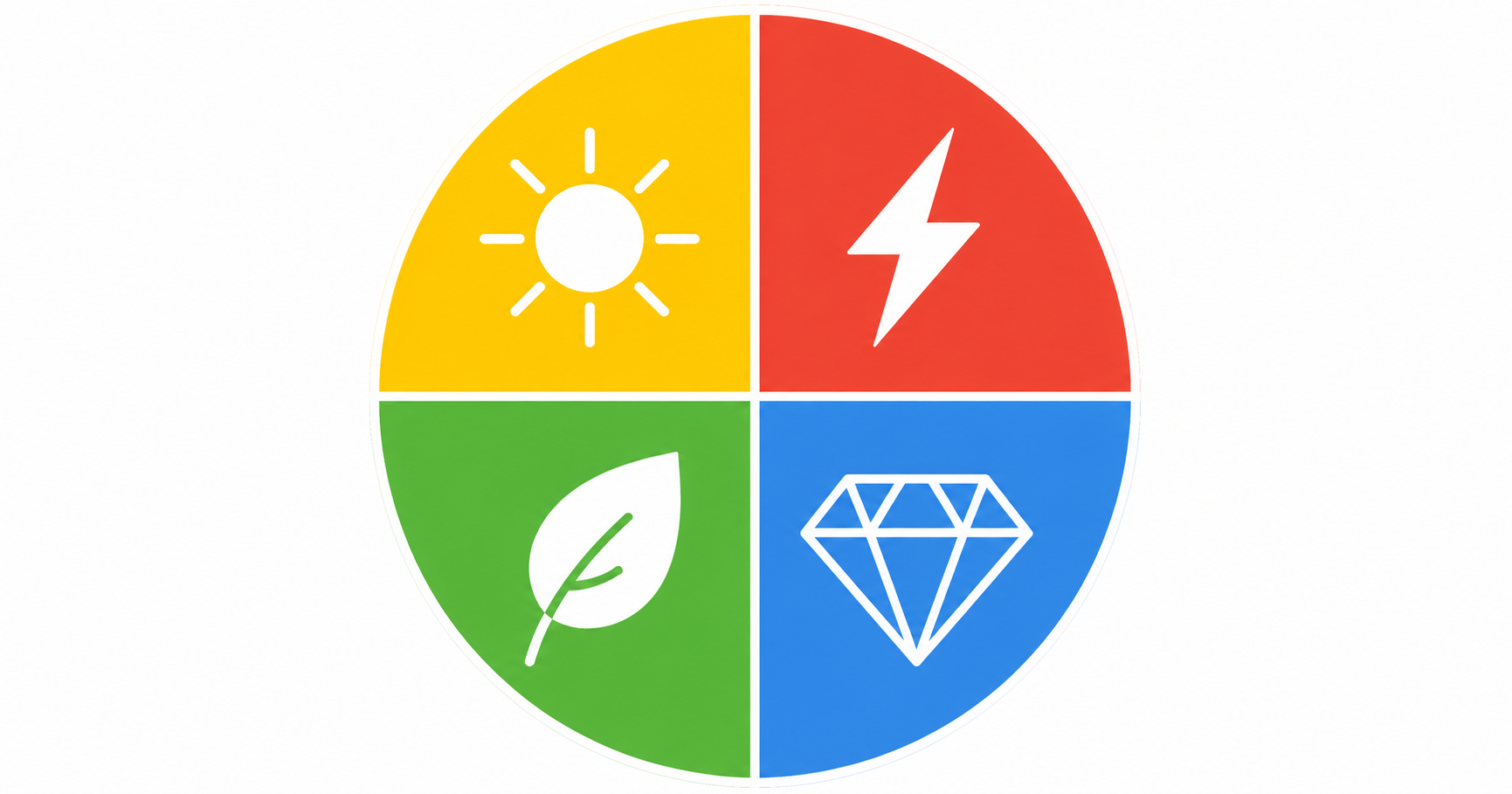
Direct, decisive, and determined. People who lead with Fiery Red energy are motivated by results and move quickly toward them. They are comfortable making decisions with incomplete information, willing to push back when they disagree, and tend to create momentum wherever they go. In a team context, they are often the ones who call out what is not working and push for resolution. Their challenge is that the same directness and pace that makes them effective can land as impatience or insensitivity, particularly with people who need more time to process or who prioritize harmony.
Sunshine Yellow — Enthusiastic and sociable
Optimistic, persuasive, and energizing. People who lead with Sunshine Yellow build relationships and generate ideas with apparent ease. They draw others in, create positive energy in a room, and are often the connectors who make collaboration feel natural. Their challenge is execution: the enthusiasm that makes them effective at generating momentum can work against them when a project requires sustained attention to detail or follow-through on commitments made in the excitement of a new idea.
Earth Green — Caring and values-driven
Patient, loyal, and deeply committed to values. People who lead with Earth Green are natural listeners. They create psychological safety, hold teams together during difficult periods, and notice when someone is struggling before anyone else does. They are the people who make sure a team actually functions as a team rather than a collection of individuals. Their challenge is self-assertion: speaking up when their values are compromised, pushing back when they disagree, and engaging with conflict directly rather than absorbing it.
Cool Blue — Analytical and precise
Thorough, objective, and systematic. People who lead with Cool Blue energy bring rigor and accuracy to everything they touch. They gather information carefully before reaching conclusions, maintain high standards, and consistently find the flaw in a plan that everyone else missed. In a team, they are the quality check that prevents costly errors. Their challenge is pace: in environments where speed matters, the need for completeness can create friction with people who are oriented toward action first and refinement later.
No color energy is inherently stronger or more valuable than another. The practical value of Insights Discovery comes from understanding how different energies interact, and from developing the ability to adapt how you communicate based on what you observe in others.
How the Insights Discovery assessment works
The evaluator consists of approximately 25 questions in which respondents choose between pairs of words or phrases that describe them. It takes around 15 to 20 minutes to complete and is done online. The process is straightforward and does not require any preparation from participants.
The output is a personal profile of more than 20 pages that includes the individual’s dominant color energy, their position on the Insights wheel, communication preferences, natural strengths, and potential blind spots. It also includes a section on how the person behaves under pressure, which often differs from their everyday preferences.
One of the most distinctive features of Insights Discovery is its conscious and less conscious layer. The profile captures not only how a person presents themselves to the world but also how they tend to behave when under pressure, when their resources are stretched, or when things are not going according to plan. These two layers do not always align, and the gap between them is often where the most productive coaching conversations begin. Tools like MindSonar go further by measuring how someone thinks within a specific context, which is particularly useful when the coaching goal is tied to a precise situation rather than general self-awareness.
Profiles are always delivered and interpreted by a licensed Insights Discovery practitioner. This is intentional. The four-color framework is simple enough that people can misapply it without realizing they are doing so. A trained practitioner understands how to facilitate conversations that move beyond the labels and into the behavioral nuances that actually change how people work together.
Where Insights Discovery delivers real value
Insights Discovery has a specific range of applications where it consistently delivers strong results. These are the contexts where its combination of simplicity, memorability, and Jungian depth works in its favor.
Team communication. The color energy framework gives teams a shared, neutral language for talking about differences without it feeling personal or accusatory. When a Cool Blue team member understands that their Fiery Red colleague’s directness is a preference and not a provocation, the entire dynamic of their interactions can shift. Teams that embed the color language into their regular conversations, not just the workshop itself, consistently report stronger communication and lower friction over time. Organizations working on deeper team development beyond communication styles often combine Insights Discovery with tools that map the cognitive diversity of the group in their actual work context.
Leadership development. Insights Discovery is particularly effective for helping leaders understand the gap between how they intend to show up and how they are actually experienced by others. A Fiery Red leader who drives results but leaves a trail of disengaged Earth Greens behind them gains something concrete and actionable from seeing that dynamic made explicit. The color energy model describes tendencies. Understanding exactly how a leader thinks and what they value inside their specific role is a different layer, one that tools focused on context-specific leadership measurement are designed to address.
Coaching. The profile gives coaches a structured starting point that accelerates the early stages of a coaching relationship. Rather than spending several sessions building a picture of how a client thinks and communicates, the profile brings that into the room immediately. The conversation can start deeper and move faster as a result.
Conflict resolution. When two people understand that their friction is rooted in opposite color energies rather than personal incompatibility, the conflict loses much of its charge. Insights Discovery provides a framework for reframing interpersonal tension in a way that feels factual rather than judgmental, which makes it easier for both parties to engage constructively.
Onboarding. Introducing Insights Discovery early in a new employee’s experience helps them understand the existing team dynamic and find their place within it more quickly. Organizations that want a more precise picture of how a candidate’s thinking patterns match the demands of a specific role before they start often use context-based psychometric benchmarking alongside the onboarding process.
Sales and customer communication. Some organizations train their sales teams to read the color energy signals a prospect gives early in a conversation and adapt accordingly. A Cool Blue buyer needs data, time, and precision. A Sunshine Yellow buyer needs enthusiasm and vision. Insights Discovery gives salespeople a practical framework for making that adaptation in real time rather than applying the same pitch to every conversation.
Real-world impact
Global technology company Indeed documented cost savings of over $10 million after embedding Insights Discovery into their onboarding and development programs. An independent ROI study found that for every dollar spent on Insights Discovery, $20.63 is returned.
Its real limitations — what practitioners need to know
Insights Discovery is a strong tool for specific purposes. It is also a tool with real limits, and understanding them matters for any practitioner who wants to use it responsibly.
It produces a static profile. The assessment captures how a person responds to a set of questions at a specific point in time. A person who completes it after a difficult week may produce a meaningfully different profile than they would on a stable one. The tool itself acknowledges that people can shi