


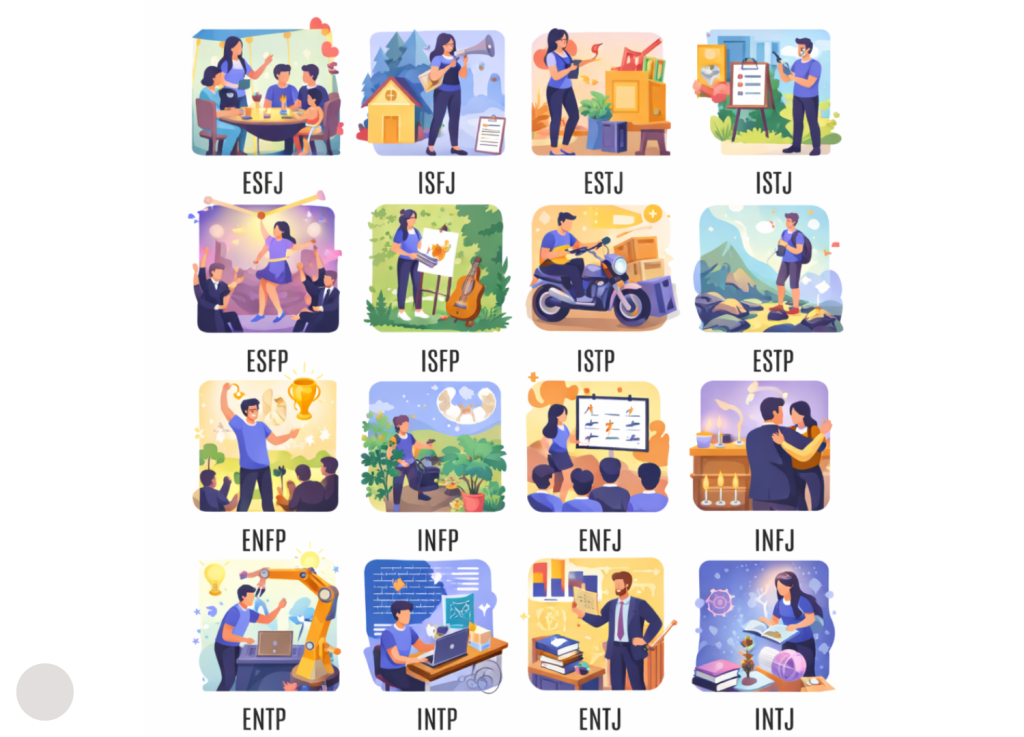
The Myers-Briggs Type Indicator (MBTI) is the most widely used personality assessment in the world. More than 2 million people complete the MBTI every year in coaching, human resources, leadership development, and team building contexts across more than 115 countries.
If you work with people as a coach, consultant, HR professional, or team leader, the MBTI has probably already crossed your path. This guide explains exactly what it measures, how it works, what the 16 types mean, and how to apply the MBTI for organizations and teams in real contexts.
people complete the MBTI assessment every year. It is the most globally recognized psychometric test in coaching and organizational development environments.
In this article
- What is the MBTI personality test?
- MBTI history and origin
- How the MBTI assessment works: the four axes
- The 16 MBTI personality types explained
- MBTI for organizations and coaching
- How to apply the MBTI for team building
- MBTI vs DISC, Big Five and other tools
- When you need to go beyond the MBTI
- Frequently asked questions
What is the MBTI personality test?
The MBTI personality test is a psychometric instrument that classifies people’s personalities into 16 types, based on four dimensions of psychological preferences. Unlike other instruments that measure behavioral traits, the MBTI assessment seeks to identify how a person perceives the world and how they make decisions.
It is used by organizations of all kinds, from Olympic sports teams to multinational corporations, to improve communication, develop leaders, optimize personnel selection, and strengthen team cohesion. The MBTI for organizations has become a standard tool in HR departments and coaching practices worldwide.

MBTI history and origin: from Jung to today
The MBTI was developed by Katharine Cook Briggs and her daughter Isabel Briggs Myers during World War II. Its original goal was to help women entering the labor market identify the roles best suited to their profile.
Its theoretical basis is the theory of psychological types by Swiss psychiatrist Carl Gustav Jung, published in 1921. Jung proposed that people differ in how they perceive the world and how they make decisions, and that these differences can be organized into recognizable patterns.
Officially published in 1962, it is today administered by The Myers-Briggs Company with a presence in more than 115 countries and translations into more than 30 languages. It is the most widely used psychometric test in the world for personal and organizational development.
How the MBTI assessment works: the four axes
The MBTI assessment measures psychological preferences across four dimensions. In each dimension, a person tends toward one of two poles. The combination of the four preferences generates one of the 16 possible MBTI personality types.
Axis 1
Extraversion (E) vs. Introversion (I)
Where does this person get their energy? Extraverts energize through interaction with the outer world. Introverts energize through their inner world: ideas, reflection, and quiet moments.
Axis 2
Sensing (S) vs. Intuition (N)
How does this person process information? S types focus on concrete data and verifiable facts. N types see patterns, possibilities, and connections between abstract ideas.
Axis 3
Thinking (T) vs. Feeling (F)
How does this person make decisions? T types prioritize logic and objective analysis. F types prioritize values, relationships, and the human impact of decisions.
Axis 4
Judging (J) vs. Perceiving (P)
How does this person relate to the outer world? J types seek structure, planning, and closure. P types prefer flexibility, spontaneity, and keeping options open.
The 16 MBTI personality types explained
Each combination of the four preferences in the MBTI assessment generates a unique personality type with characteristic strengths and areas for development. Here are all 16 MBTI personality types organized by their natural groups.
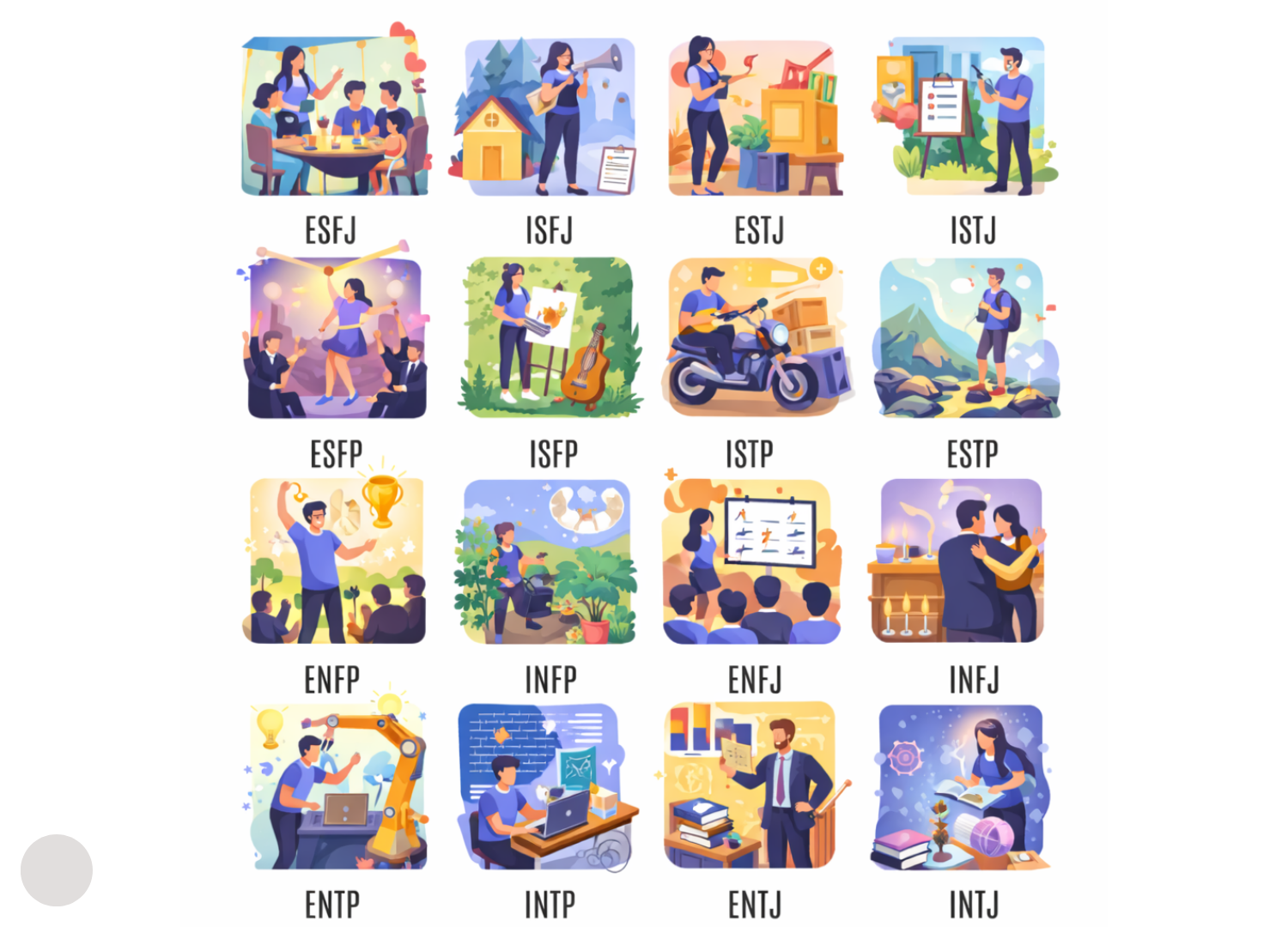
Analysts (NT)
| INTJ — Architect | Strategic and independent. Works methodically toward long-term goals. Excellent at complex problem solving and strategic planning. |
| INTP — Thinker | Analytical and curious. Brings deep intellectual thinking and easily identifies logical inconsistencies. |
| ENTJ — Commander | Decisive and results-driven. Transforms visions into concrete plans and mobilizes teams toward goals. |
| ENTP — Innovator | Creative and entrepreneurial. Enjoys challenging conventions and generating new ideas in dynamic environments. |
Diplomats (NF)
| INFJ — Counselor | Empathetic and visionary. Has a unique ability to understand people and motivate them toward a higher purpose. |
| INFP — Mediator | Idealistic and values-driven. Seeks meaning in everything and connects deeply with people on an emotional level. |
| ENFJ — Protagonist | Charismatic and inspiring. Natural at mobilizing teams toward a shared vision. Excellent communicator and facilitator. |
| ENFP — Campaigner | Enthusiastic and creative. Generates energy and inspires those around them. Excels where innovation and relationships matter. |
Sentinels (SJ)
| ISTJ — Inspector | Responsible and reliable. One of the most common types in corporate environments. Excellent at managing processes and maintaining quality standards. |
| ISFJ — Protector | Dedicated and warm. Excels supporting others and maintaining team harmony. Strong in HR and customer-facing roles. |
| ESTJ — Director | Organized and results-driven. Sets clear standards and ensures teams meet them efficiently. Natural in management roles. |
| ESFJ — Consul | Sociable and people-oriented. Creates positive, cohesive work environments. Excellent at coordination and collaboration. |
Explorers (SP)
| ISTP — Virtuoso | Practical and analytical. Excels at solving technical problems with applied logic and fast adaptation. |
| ISFP — Adventurer | Flexible and sensitive. Brings creativity and authenticity to the team. Works well independently. |
| ESTP — Entrepreneur | Energetic and action-oriented. Excels in high-pressure environments. Strong negotiator and crisis manager. |
| ESFP — Entertainer | Spontaneous and people-focused. Creates motivating environments. Excels in roles requiring energy and connection. |
MBTI for organizations: applications in coaching and teams
The MBTI assessment has concrete, well-documented applications across different professional contexts. These are the most common uses of the MBTI for organizations and professional teams.
Individual coaching. As a starting point for exploring the client’s natural preferences, communication style, and decision-making patterns. It helps articulate aspects of personality that the client senses but does not know how to name. See how MindSonar is used in coaching contexts.
MBTI team building. Opens conversations about why different people approach the same problems in different ways. When a team understands that differences are about preference rather than attitude, communication improves notably. Explore team building with psychometric tools.
Leadership development. Helps leaders reflect on their natural management style, strengths, and areas for growth. Especially useful in executive development programs as a self-awareness entry point. Read about leadership development with MindSonar.
Career guidance. Helps identify work environments and role types more aligned with a person’s natural preferences. A useful compass for career decisions and professional transitions.
Conflict resolution. Helps understand why two well-intentioned people can generate friction. Identifying type differences helps find common ground and improve collaboration.
Onboarding and organizational culture. Some HR teams use the MBTI assessment during new employee onboarding to facilitate team integration and anticipate potential cultural friction points. See how psychometrics improve recruitment decisions.
of Fortune 500 companies have used the MBTI assessment at some point in their talent development and leadership programs.
How to apply the MBTI for team building: a practical guide
To get the most value from the MBTI assessment in an organizational context, these are the steps the most experienced professionals follow.
- Define the objective before applying it. The MBTI is a tool, not an end in itself. Before applying it, define what you want to achieve: improve team communication, identify leadership styles, or facilitate a conversation about cognitive diversity.
- Apply it with a certified professional. MBTI results are most valuable when a trained professional interprets them and facilitates the conversation. Without that support, profiles become labels without action.
- Create a space for reflection, not classification. The MBTI personality test works best as a starting point for conversation rather than as a definitive label. Invite the team to explore results with curiosity, not rigidity.
- Connect results to concrete situations. Translate types into observable behaviors within the team. An ENTJ and an INFP can work together very effectively once they understand each other’s preferences.
- Follow through. The biggest mistake is applying the MBTI once and filing it away. Its real value appears when results are integrated into team conversations, meetings, and ongoing development processes.
MBTI vs DISC, Big Five, Hogan and MindSonar: full comparison
The MBTI personality test is not the only available option. Depending on your objectives, there are tools with meaningfully different approaches. This comparison covers the most searched questions: MBTI vs DISC, MBTI vs Big Five, and how each one differs in practice.