World boxing champion has a unique combination of thinking styles.

Esther María de Los Ángeles Micheo Santizo is a Guatemalan athlete, outstanding in her sports career as well as a successful entrepreneur.  María, The Unstoppable <<la imparable>> Micheo, is a unique athlete, who practices different sports, and gives herself to them with passion. She has specifically excelled in Karate, where she holds a Black Belt III Dan (48/51 kg.) obtaining the following triumphs:

• National Karate Champion (2001, 2012)

• Karate Do Gold Medals 2001 to 2012

• Gold medals in invitational tournaments (Guatemala, Salvador and Nicaragua) 2001-2012

• Gold Medal Murayama Cup, Mexico 2008

• Bronze medal – Team tournaments- USA Open, Las Vegas 2008

• Bronze Medal Central American and Caribbean Championship Karate Do (2007-2009)

In addition, she has participated in 5K and 10K races and half marathon (Antigua, Guatemala 21 km), where she obtained the first places.

She then decided to train in MMA (Mixed Martial Arts), where she participated in  6 fights, winning them all.  After, she began dabbling in boxing, which is her new passion. She is now a professional boxer, has participated in 8 fights, and is the current Champion for the WBC International Absolute Title.
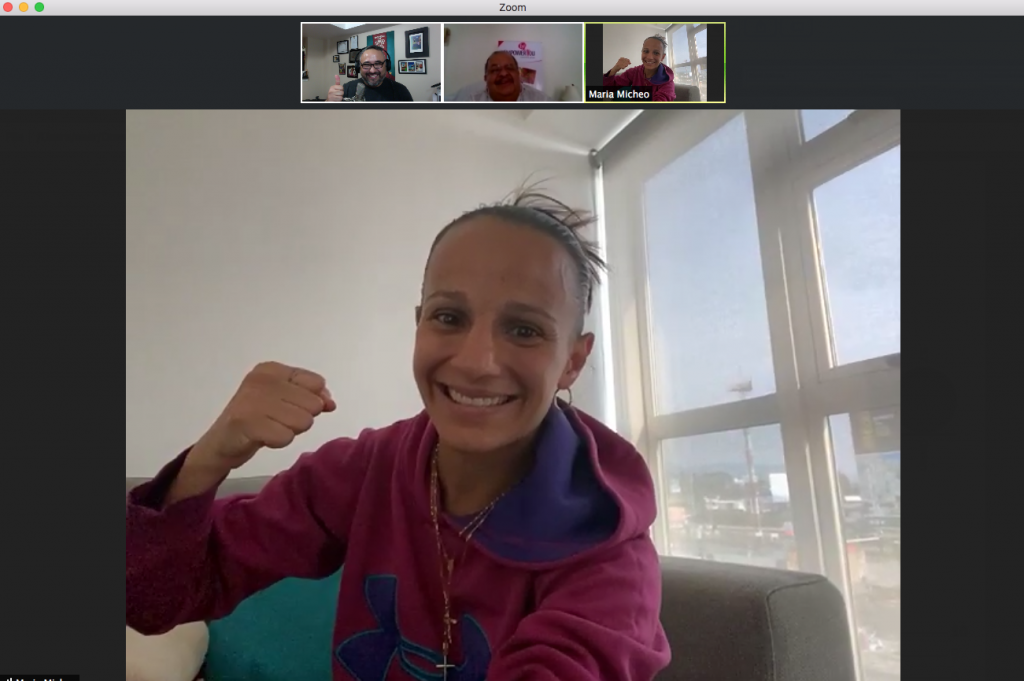
Micheo, Sergio Saenz and Jaime Leal during the MindSonar results

María, in addition to being a successful athlete, is also an entrepreneur. She is the owner and founder of the Micheo Boxing Academy, located in one of the most prestigious shopping centers in Guatemala.

With the arrival of Covid-19, Maria’s business was impacted negatively, and her competition scheduled for July was postponed. This has not stopped the titleholder, who is now teaching virtual classes to her students, and is continuing  with her training for her next fight. To earn additional income, she has launched a startup of heathy cupcakes.

Metaprofile

Not surprisingly, this high-performance, enterprising athlete’s predominant Graves Drives, are order and power.

In professional boxing it is very important to maintain and present yourself to a fight with the exact weight. A few grams too many or too few means a penalty for the boxer. The blue Graves Drive keep her disciplined, in shape, and exerts great control in her lifestyle.   Additionally, as an entrepreneur with several businesses, she needs to be disciplined with her time, finances, and consistency. We can also see that her criteria are closely aligned with her predominant Graves. Her preparation and maintaining her exact weight boost her self-confidence.

She is well aware of her reputation and the importance of her name when she wins a fight or is starting up a business with her name.  That is well aligned with her high Power Graves Drive.  It keeps her earning titles and continuing with her training regimen so that when she fights, her name can get a wide audience.

Her highest metaprograms are Towards, Matching, Internal Locus of Control, and Proactive.

Being a high achiever, it is natural that her highest metaprogram is Towards.  She sets goals and focuses on how to reach them, and with high Matching, she sees no obstacles to winning. After establishing her goals, she develops an action plan (Blue Graves), and jumps into action (proactive metaprogram). It is not surprising that her internal Locus of Control is another predominant metaprogram, since she depends on her sense of discipline and her preparation to obtain the best results. However, this Metaprogram changes radically when she is in the ring, according to our conversation: “I only execute what my coach tells me to do, I pay attention to everything, but my coach is the one in control”. While Maria is in the ring, she is attentive to her coach’s vision and opinion, keeping her focus on her goal but shifting to an external reference and external locus of control.  Micheo comments in the interview that one of her mistakes in the past was not trusting her coach, and that not having a coach that she could fully trust, was something that affected her negatively in the past. Today she has managed to overcome her distrust which helps her win more often. It is an interesting mix of Metaprograms for sure!

In addition, her strong options and specific metaprograms allow her to identify the different alternatives during the event, to make quick decisions and achieve her goals.

We deeply thank the Guatemalan champion for allowing us to learn more about the way a champion thinks.  There is no doubt that the combinations of Metaprograms and the emotional intelligence to know how to handle them to her advantage, are part of the sustained success of María Micheo, a talent still in the making.

For our Mindsonar Professionals:

1. It is important not only to recognize thought patterns, but to understand how our clients use them to manage the criteria. In this sense, the delivery of results and the conversation around them are key.

In her evaluation, her high ILC result changed completely in the conversation, where she made it clear that she has a high ELC when fighting, as she follows the instructions of her coach, she is there just to execute the plan, her Coach has a huge role in control.

2. Rare/infrequent combinations of thinking patterns can also have positive results.

3. As MindSonar professionals, our thinking patterns also play a role in the analysis of the MindSonar report.

Professionals who conducted the study

Sergio Saenz and Dr. Jaime Leal With the contribution of Debbie Yarhi

Improving Relationships with MindSonar

As I’m writing this on the eve of Valentine’s Day, I thought I’d take a look at how MindSonar might be useful in the work I do with clients experiencing minor, but constant, conflict in their relationship with their partner. You know the sort of thing – arguments that seem to flare up  from nowhere, over nothing.  I’ve worked with clients who tell me that they and their partner have no major differences in values, political views, religious beliefs, etc. and yet seem to end up bickering daily about minor things. These arguments, although seemingly unimportant, can gradually start to impact upon the relationship, making one or both partners unhappy.  In turn, this can lead to bigger arguments and so set up a destructive cycle.

This sort of conflict is very often due to the meta programmes being used by the individuals.   Common problems that I see are:

  • One or both partners running a Mismatching meta programme in everyday life. Constantly seeing what is wrong gets in the way of appreciating the things that are right. In a relationship this can lead to a perception that the partner is a negative thinker, down on everything – even a nag. That said, there are times when running a Matching programme can also lead to problems, particularly when a couple is planning a major change in lifestyle, with the risk of the “matcher” being seen as not being realistic about problems and obstacles that might need to be considered in order to succeed.
  • One partner is Internally Referenced and the other is Externally Referenced. In this situation, the internally referenced partner might be frustrated that, when they are thinking aloud about things that need to be done, the externally referenced partner immediately does it – taking the partner’s words as an instruction, not just a thought.  I have certainly experienced this, and the frustration that it can cause if not understood simply as a difference in thinking patterns.
  • One partner has a strong Options meta programme, and the other is highly Procedural.  This difference often causes unexpected  arguments when the couple are planning something about which each is excited – a holiday or a celebration for example.  They begin by feeling great as they start to arrange it, but end up bickering as the two meta programmes cause frustrations as they begin to plan.

In fact, large differences in any of the meta programmes can lead to feelings of being misunderstood or not listened – the basis of many disagreements.

By jointly experiencing a MindSonar assessment and coaching session, the couple can gain an understanding of the underlining differences in their thinking styles and the way that this is impacting upon them.  As MindSonar stresses the usefulness and equality  of each meta programme, the couples can learn to appreciate their differences, rather than to judge them.

Such a session could provide the couple with the following benefits:

  • Each partner can get an insight both into the meta programmes in play in their chosen context.
  • Each can become aware of occasions when they have run the other meta programmes, thus recognising them as flexible ways of thinking, rather than as inherent ways of being.
  • The couples can also “try out” the other’s meta programmes with their given context in mind to gain their perspective on the situation.

Overall, MindSonar can enable couples to appreciate each other’s thinking style and also identify how they could use such differences to complement, rather than conflict with, each other.

Couples work is just one example of the flexibility of MindSonar in working on conflict resolution, and highlights its usefulness in personal as well as business coaching.  I’ll certainly be recommending it to my clients.

Working with new managers

WORKING WITH NEW MANAGERS

Over the years, I’ve found that a common client problem that is brought to coaching is that of a newly-promoted manager struggling with a promotion from team member to team leader. The related changes to the relationship with members of their team, coupled with developing a leadership mentality often leaves them feeling stressed and insecure about whether or not they are performing their new role effectively.

Since training in MindSonar, it has become apparent to me that one of the underlying causes of the stress lies in the client’s manager not recognising my client’s need for feedback on their performance during the early stages of their new role.   The more senior managers are generally experienced leaders who are expected to take initiative and make decisions. Consequently, they tend to be predominantly Internally Referenced. This can result in them not recognising (or remembering) that new managers may be more Externally Referenced in the context of their new roles, requiring some feedback on how they are progressing.  This difference can lead to new managers being left to their own devices and feeling unsupported, as their managers believe that they’ll either cope or request support as and when needed.

Less often, new managers feel they are not trusted because they feel that their manager is micro-managing them and giving feedback far too often.  Such cases are less frequent, but can also arise from a disparity between the Internally/Externally Referenced Meta Programmes.

In larger organisations, formal structures may exist in which regular feedback meetings are undertaken, but these still operate on the assumption that all staff are running the same thinking patterns, which of course is not the case. The result is that some feel that such meetings are too infrequent (those who are highly Externally Referenced) and some feel that it is micro-management (those who are more Internally Referenced).  Many smaller businesses have no feedback procedures at all.

If middle and senior managers were to invest in MindSonar profiles for their direct reports, they could tailor their approach to individuals, giving more frequent feedback to those who prefer it (the Externally referenced individuals), and feedback on a “as needed” basis to those who do not (the Internally referenced individuals).  This would reduce the stress and insecurity felt by all members of the team, whether new to post or not. As a result, team members will feel more motivated and so develop within their roles more productively.

Of course, there are other Meta Programmes which are at play in such circumstances, especially around the changing context of moving from team member to team leader.  The MindSonar profiles will also enable more experienced managers to support their junior managers to handle those changes too.

If you are a middle or senior manager who would like to get the most from your junior managers, then contact your local MindSonar Professional to learn more about how MindSonar could enable you to get the best out of your team, and keep each team member motivated and less stressed.

If you’re a coach who works with managers at any level, then you’ll find becoming a MindSonar Professional a really worthwhile addition to your coaching toolkit, so do consider adding it as soon as you can.

The Manager who didn’t want to Live in the Now

By Jantina Wijtsma

I was coaching Bert, a manager who worked for a non-profit organization. Bert had a whole list of questions for me:

  • “How can I manage my team to be ready for the future?”
  • “How can I renew the values in the team asap?”
  • “How can I move us forward fast?”
  • “How can I quickly achieve the best results for the company with the people I manage?”
  • “How can I earn money for us in the future?”Continue reading

New year resolutions – could understanding thinking styles make them more successful?

Every January the gyms become busier, the supermarkets’ salad section gets depleted and so-called slimming products fly off the shelves. Magazines (online and off) are filled with advice about goal-setting and making change. Yet, every year, everything’s back to normal by February with very little to show for early January’s enthusiasm. Most New Year resolutions are abandoned before January is even finished. Maybe next year…

So, are New Year’s resolutions worth making, or not? With such a high failure rate, is there really a point to them? I think it all depends on a person’s perspective and the way that they view the goal they are setting themselves. Understanding which meta programmes could be contributing to a person’s failure to achieve their resolutions could enable the switch in thinking patterns needed to bring about success. Here are some examples I’ve come across:

Procedure and Specific metaprogrammes
One problem with New Year’s resolutions is that for some people they are often just that — something for the new year. With this perspective, the resolutions are approached as if they have to be started on 1st January and executed perfectly until successfully achieved. As soon as the person falters, they view that as a failure, decide they can’t do it and give up.

My initial take on this is that perhaps these people are running strong Procedure and Specific metaprogrammes, possibly with a strong Blue (Order) Graves Drive. In such cases the problems lie with the belief that to achieve a goal you need to go from start to finish in a straight line, in a certain way with no hiccoughs, pauses or detours. Anything else is seen as disheartening and a personal failure. This means that those with such a perspective are bound to fail as the vast majority of things worth achieving take time, effort and involve learning about what works and what doesn’t along the way.

Strengthening the Options and General metaprogrammes might enable this person to see the broader picture and find more ways than one to achieve their goals.

Change and Present metaprogrammes
Another thing that some to abandon their resolutions is that some people become disheartened when they perceive that their progress is slow and gradual. Perhaps this is due to a strong desire for noticeable results to happen quickly – a high Change metaprogramme, especially if coupled with a Present perspective.

In this case, strengthening Development and Future metaprogrammes may enable the acceptance of gradual progress to future success.

External Locus of Control
Thirdly, many abandon their resolutions because they feel that events around them get in the way. Often this is due to a high External Locus of Control and the resulting discounting of their own ability to take control of their behaviours and decisions.

For these clients strengthening Internal Locus of Control can enable them to make the decisions and changes they need to in order to achieve their goals, whatever is going on around them.

These are just a few of the ways that understanding thinking styles can enable us to achieve our (and our clients’) new year goals. Other metaprogrammes can also be at play in this situation of course, and the analysis provided by a MindSonar profile in this context can help us determine these.
Do let me know your thoughts and experiences on this – I’d be interested in what thinking styles you find are a help or a hindrance with your new year resolutions.

How are you most productive?

How is that the environment we work in can either enhance our productivity or inhibit it? This Meta Program pattern plays a huge roll in how beneficial a working environment can be for motivating and supporting those in it. Many people will also discover that they have more than one pattern in any given setting, a dominant and a secondary style.

Continue reading