Rotters ‘Locus of Control’, is it the same as our Meta Programs?

Internal Locus of Control’ is, as you are probably well aware, defined as having a focus one how one influences ones circumstances, while versus ‘External Locus of Control’ is having a focus one how ones circumstances influence oneself.

They most probably came from Rotter
The locus of control meta programs are closely related to Rotter’s (1989) distinction bearing the same name. It seems highly likely that this distinction found its way directly from Rotter into the meta program collection. According to Rotter, ‘Locus of control’ describes “the degree to which a person explains outcomes and events in their personal life as due to – chance- fate- luck, or as a result of her/his own – skills- abilities- goal-directed behaviour”. Rotter conceptualised locus of control as variable, based on the circumstances and therefore different in different situations. For instance, situations differ in terms of the clarity of the reinforcement contingencies operating, i.e. how clear it is which behaviour will be rewarded or punished. Clear reinforcement contingencies increase the chance of internal locus of control, while unclear reinforcement contingencies increase the chance of external locus of control.

Social learning theory
Rotter derived the concept from social learning theory (Bandura, 1977). This theory holds that we observe and imitate the behaviour of people around us. Imitation is influenced by the rewards the behaviour is perceived to result in. If the perceived rewards outweigh the perceived costs, then the behaviour will be more likely to be imitated. Therefore, regarding the ‘control’ in Rotters term ‘locus of control’ is control of social reinforcement (being rewarded or punished by ones fellow humans). A logical consequence is, that when reinforcement conditions change, the perceived locus of control may shift as well.

The ‘Internal–External (I-E) scale
Rotter (1966) produced a  29-item questionnaire called the ‘Internal–External (I-E) scale’, measuring to what extent someone believes events are contingent on their own behaviour or their own relatively permanent characteristics or traits (i.e., internal predisposition), or whether they believe that events are contingent on  luck,  chance,  fate,  or  factors beyond their control (i.e., external predisposition). Studies have shown Gurin et al.’s 13-item scale’s validity for measuring the core construct of internal versus external control of reinforcement (Greenberger, Strasser, Cummings,  & Dunham, 1989; Howell & Avolio, 1993).

In this measurement, respondents are presented with 13 sets of two statements and asked to choose the one describing best how they feel. 1. Many of the unhappy things in people’s lives are partly due to bad luckPeople’s misfortunes result from the mistakes they make.2. One of the major reasons why we have wars is because people don’t take enough interest in politics.There will always be wars, no matter how hard people try to prevent them.3. In the long run, people get the respect they deserve in this world.Unfortunately, an individual’s worth often passes unrecognised no matter how hard he tries.4. The idea that teachers are unfair to students is nonsense.Most students don’t realize the extent to which their grades are influenced by accidental happenings.5. Without the right breaks, one cannot be an effective leader.Capable people who fail to became leaders have not taken advantage of their opportunities.6. No matter how hard you try, some people just don’t like you.People who can’t get others to like them don’t understand how to get along with others.7. I have often found that what is going to happen will happen.Trusting to fate has never turned out as well for me as making a decision to take a definite course of action.8. In the case of the well prepared student, there is rarely, if ever, such a thing as an unfair test.Many times exam questions tend to be so unrelated to course work that studying is really useless.9. Becoming a success is a matter of hard work; luck has little or nothing to do with it.Getting a good job depends mainly on being in the right place at the right time.10. The average citizen can have an influence in government decisions.This world is run by the few people in power, and there is not much the little guy can do about it.11. When I make plans, I am almost certain that I can make them work.It is not always wise to plan too far ahead because many things turn out to be a matter of luck anyway.12. In my case, getting what I want has little or nothing to do with luck.Many times we might just as well decide what to do by flipping a coin.13. What happens to me is my own doing.Sometimes I feel that I don’t have enough control over the direction my life is taking.

Looking at these statements, we see that 7 sets refer to having control over specific types of reward or punishment, while 6 items refer to general events:Specific itemsSet 2: Having warsSet 3: Receiving respect and recognitionSet 4: Receiving good grades as a studentSet 5: Becoming a leaderSet 6: People liking youSet 8: Being tested fairly as a studentSet 10: Influencing government decisionsGeneral itemsSet 1: Having bad luck and misfortuneSet 7: What is going to happenSet 9: Having successSet 11: Making plans workSet 12: Getting what I wantSet 13: What happens to me

Comparison with Rotters ‘Locus of control’
a. Conceptually, the meta program set ‘Internal’ versus ‘External locus of control’ is almost identical to Rotters ‘Locus of control’. Although we have no evidence of this, it seems likely that this meta program set was derived directly from Rotters work.

b. Both Rotter and meta programs assume that locus of control may vary depending on the context.c. In the short form of his measurement, the ‘Internal–External (I-E) scale’, Rotter defines 7 specific contexts (in 7 out of the 13 items). This is a difference with meta programs, since MindSonar only uses one single context (chosen by the respondent or the organisation using MindSonar).d. The definition of the meta program set may benefit from Rotters specification of three sources of internal and external locus of control each. Rotter mentions “chance, fate and luck” as sources of external locus of control and “skills, abilities and goal-directed behaviour” as sources of internal locus of control.

Skill, ability, chance and fate
Although these sources are almost synonymous, they are not exactly the same. ‘Skill’ refers to a specific ability, a specific expertise. ‘Ability’ is a more general concept: proficiency in a particular area (which may be made up of multiple skills and a mental strategy to manage them). ‘Goal-directed behaviour’ is more specific than ‘skill’, it might even refer to a single action. These three sources are on a general-to-specific continuum: ability – skill- goal-directed behaviour.

Looking at the sources of external locus of control, we see that ‘chance’ is the occurrence of events in the absence of any obvious intention or cause. This is a broad concept that does not even attribute the cause of the events to any outside forces either. ‘Fate’ is when events are predetermined by a supernatural power, which is outside a person’s control. ‘Fate’ is a little more specific that ‘chance’; fate at least contributes the events to something. ‘Luck’ is when success or failure are apparently brought by chance rather than through one’s own actions. Luck is more specific again than chance, it’s not about events in general, but about success or failure. With his specification of the courts, Rotter covers both general and (a little) more specific reasons for where the perceived control lies.

‘Options’ versus ‘Procedure’, is it the same as ‘Judging’ versus ‘Perceiving’?

As you probably know, the meta program options’ is defined as a preference for having many different possibilities, while its counterpart ‘procedure’ is characterised by a preference to use step-by-step plans. These meta programs are related to the ‘Rule/group conformity’ and the ‘Sufficiency/proliferation of originality’ subscales of  the ‘Kirton Adaption–Innovation (AI) continuum of cognitive style’ (Kirton, 1987) as well as the distinction between ‘judging’ and ‘perceiving’ in Myer’s addition to Jung’s theory of psychological types (Geyer, 1995).

Kirton: Adaption versus innovation
Kirton describes adaptors as “conforming to the established procedures or ways of doing things – these established procedures represent the step-by-step planning which is learned by experience and guidelines and is the opposite of seeing possibilities and aiming for change”. Adaptors also seek collaboration in problem solving and conform to rules and groups (personal or informal structures). Innovators seek new and unique ways (which also means new possibilities) and are not likely to pay attention to tradition and consensus but are more likely to break the rules and make unexpected decisions. Items in the Kirton Adaption–Innovation inventory that measure rule/group conformity are (Kirton, 1976):
20. Imposes strict order on matters with their control
21. Fits readily into “the system”
22. Conforms
23. Readily agrees with the team at work
24. Never seeks to bend or break the rules
25. Never acts without proper authority
26. Is prudent when dealing with authority
27. Likes the protection of precise instructions
28. Is predictable
29. Prefers colleagues who never “rock the boat”
30. Likes bosses and work patterns which are consistent.
31. Works without deviation in a prescribed way
32. Holds back ideas until obviously needed.

Items in the Kirton Adaption–Innovation inventory that measure ‘sufficiency/proliferation of originality’ are (Kirton, 1976):
1. Has original ideas
2. Proliferates ideas
3. Is stimulating
4. Copes with several new ideas at the time
5. Will always think of something when stuck
6. Would sooner create than improve
7. Has fresh perspectives on old problems
8. Often risks doing things differently
9. Likes to vary set routines at a moment’s notice
10. Prefers to work on one problem the time
11. Can stand out in disagreement with the group
12. Need the stimulation of frequent change
13. Prefers changes to occur gradually

Psychological types: judging versus perceiving
Jung distinguished 8 psychological types. He theorised that the dominant function in these types (extraverted/ introverted and sensing/intuition/ thinking/feeling) characterises consciousness, while its opposite is repressed and characterises unconscious behaviour (Jung, 1933). The judging/perceiving distinction, which was added later to Jung’s original types by Myer, reflects whether a person relies primarily on a judging process (thinking or feeling) or a perceiving process (sensing or intuition) in their decision making and other dealings with the outer world.

The ‘judging’ type likes to make plans and to-do-lists.
The ‘perceiving’ type likes to stay open to the outer world (to new experiences and information).

‘Judging’ people are decisive, self-starters and self-regimented. They also focus on completing the task, knowing the essentials, and they take action quickly. They plan their work and work their plan. Deadlines are sacred as they see time as a finite resource. They want guides that give quick tips.

‘Perceiving’ people are curious, adaptable, and spontaneous. They start many tasks, want to know everything about each task, and often find it difficult to complete a task. Deadlines are meant to be stretched while more information is gathered as they see time as a renewable resource. They like to leave their options open. (Clark. 2011).

Comparison
When we compare the options and procedure meta programs with Kirton’s ‘rule/group conformity’ and ‘sufficiency/proliferation of originality’ subscale’ and with the distinction between ‘judging’ and ‘perceiving’ in Myers-Briggs, we see the following similarities and differences:

a. When Kirton describes adaptors as liking “established procedures” and “step-by-step planning” he is literally describing what we understand the meta program ‘procedure’ to mean. Likewise, his description of innovators as “seeking new and unique ways (which also means new possibilities)” is a direct description op the meta program ‘options’. So here we see a strong similarity.

b. When we look at the items in Kirton’s rule/group conformity subscale, we see that 7 items are a direct reflection of the meta program procedure (items 20, 24, 27,28, 29, 30 and 31). The other 5 items, however, reflect the meta program ‘external reference’ rather than ‘procedure’ (items 21, 22, 23, 26, and 32). From a meta program perspective, this subscale consists of 58% ‘procedure’ and 42% ‘external reference’. It looks like in the ‘rule/group conformity’ concept, the ‘rule’ element is ‘procedure’, while the ‘group’ element is ‘external reference’.

c. When we look at the items in Kirton’s ‘sufficiency/proliferation of originality’ subscale, we see that 7 items are a direct reflection of the meta program ‘options’ (items 1, 4, 5, 6, 7, 8 and 9). The other 6 items in this subscale, however, mostly reflect other meta programs. Item 11 reflects ‘internal reference’ and item 12 reflects ‘change’, while item 13 reflects ‘development’. From a meta program perspective, this subscale consists of 54% options and 46% other meta programs.c. As we mentioned before, another difference is that Kirton limits the context for his cognitive styles to working situations, while meta programs may pertain to any context.Summarising: The rule/group conformity subscale in the Kirton Adaption-Innovation continuum is a direct reflection of the meta program ‘procedure’ for about half the scale. The other half of the scale reflects ‘external reference’. Similarly, the ‘sufficiency/proliferation of originality’ subscale is a direct reflection of the meta program ‘options’ for about half the scale. The other half of the scale reflects other meta programs.a.

When we view Myer’s ‘judging’ versus ‘perceiving’ psychological types,

a. We see that the ‘judging’ type
– likes to make plans and to-do-lists
– is self-starting and self-regimented
– focuses on completing the task- plans their work and works their plan
– adheres to deadlines
– wants guides.
These are all expressions of the meta program ‘procedure’.

b. The ‘perceiving’ type
– likes to stay open to new experiences and information
– starts many tasks- often finds it difficult to complete a task
– does not adhere to deadlines
– likes to leave their options open.T
hese are all expressions of the meta program ‘options’

c. The ‘judging’ versus ‘perceiving’ distinction does not, however, reflect the ‘procedure’ versus ‘options’ meta programs exclusively.
– ‘Knowing the essentials’ (judging) reflects the meta program ‘concept’.
– ‘Taking action quickly’ (judging) reflects the meta program ‘proactive’.
– ‘Wanting to know everything about each task’ (perceiving) reflects the meta programs ‘information’ and ‘ specific’.

Summarising: To a fairly large extent the ‘judging’ versus ‘perceiving’ psychological types overlap with the meta programs ‘procedure’ versus ‘options’. However, these types also contain other meta programs as well, like ‘concept’, ‘proactive’, ‘information’ and ‘specific’.

Internal and External Reference, what is the Link with Innovation?

As you know, the meta program ‘internal reference’ is defined as: using one’s own standards in evaluations. ‘External reference’ is using other people’s standards in evaluations. What are some concepts from mainstream science that this distinction is related to?

Internal and external frames of reference in the academic self-concept
An ‘Internal/External frame of reference’-concept used in the study of academic self-concept (Marsh, 1986). When students gauge their academic self-concept by comparing their ability in a given area with the ability of their peers, this is called ‘external comparison’. When they compare their ability in one area with they own ability in other areas, that is called ‘internal comparison’.

Adaptation/Innovation
The meta programs internal reference and external reference, are also related to the ‘Kirton Adaption–Innovation (AI) continuum’ of cognitive style (Kirton, 1987). Messick (1976) defines cognitive style broadly as “consistent individual differences in preferred ways of organising and processing information and experience” (p. 5). Kirton (1999b) defines cognitive style more narrowly as the preferred style with which the individual undertakes problem solving and creativity. He asserts that cognitive style is highly resistant to change. The Kirton Adaption-Innovation (AI) continuum of cognitive style ranges from more adaptive preferences for creativity, decision making, and problem solving at one end, to more innovative preferences at the other. Kirton (1994) describes people with more adaptive preferences as being seen by others as more precise, sound, reliable, disciplined, and dependable. They are more concerned about how things get done – the means. They tend to accept the given problem definition and are more concerned with resolving problems rather than finding them. People with more adaptive preferences will generally focus on change that promotes incremental improvement, perfecting existing systems or “doing things better.” Kirton (1994) described those with a more innovative preference as being seen as unique, visionary, and ingenious. Those with a more innovative preference prefer to challenge the definition of the problem by manipulating and questioning existing assumptions. They may be seen as undisciplined and the kind of change on which they focus is perceived as more radical and often described as breakthrough. When these characteristics are operating together, more innovative people will generally prefer changing the existing system or “doing things differently.”

Focussing on others, but doing what?
When we compare the internal and external reference meta programs with Marshes (1986) Internal/External frame of reference and the Kirton Adaption-Innovation continuum, we see the following similarities and differences.

a. What the internal/external reference distinction in meta programs shares with Marshes Internal/External frame of reference model, is that in both distinctions there is a focus on self (internal reference) in one case, versus a focus on others (external reference) in the other.

b. There is also an important difference. In a comparison there are two elements: observation and evaluation. When a student compares themselves with their peers in Marshes model, they are observing others. But when they evaluate their own capability, comparing themselves with these others, they are using their own standards. If they were displaying the meta program ‘external reference’ in that situation, they would be using the standards of their peers. They would be measuring their own performance against what their peers found to be a good standard, not even necessarily observing the ability of their peers.

Summarising: Both Marshes internal/external frame of reference-concept and the internal/external reference meta programs distinguish – in a broad sense – between focus on self and focus on others. A major difference is that in Marshes model people using an external frame of reference use their own standards to evaluate their performance, while with the external referenced meta program they use the other person’s standards.

Many other meta programs in Kirton’s AI distinction

c. Looking at the Kirton Adaption–Innovation continuum, people with adaptive preferences, certainly sound more externally referenced, while people with innovative preferences clearly seem more internally referenced in terms of meta programs. Adaptive preferences are characterised by “accepting the given problem definition”. In that regard they are externally referenced: accepting the judgement of other as to what the problem is. People with innovative preferences are described as challenging the definition of the problem … and questioning existing assumptions. These are definitely internally referenced qualities.

d. But as with other concepts we have discussed in this series, Kirton’s adaptive and innovative preferences also harbour many elements that would be coded as other meta programs.
– ‘Being precise’ would be coded as ‘specific’
– ‘Reliable and disciplined’ would be coded as ‘procedure’
– ‘Undisciplined’ would be coded as ‘options’
– ‘Concerned about how things get done’ would be coded as ‘procedure’ too
– ‘Resolving problems’ would be coded as ‘away from’
– ‘Incremental improvement’ would be coded as ‘development’
– ‘Radical change’ would be coded as ‘change’
– ‘Visionary’ would be coded as ’change plus general plus visual’.
So apart from the internal/external reference distinction, Kirton’s distinction also seems to make use of the ‘general/specific’, ‘options/procedure’ and ‘maintenance/development/change’ meta programs.

e. Another difference is that Kirton sees cognitive style as ‘highly resistant to change’, while meta programs are presupposed to be different in different contexts, which also presupposes that they may often change quite easily.

Summarising: We recognise internal/external reference elements in Kirtons adaptive/innovative distinction. Apart from these two meta programs, we also recognise several other meta program distinctions, like ‘general/specific’ and ‘options/procedure’.

Towards and Away from, what does Motivational Theory say?

This is an article in the series on comparisons between meta programs and concepts in mainstream science. Today we will talk about ‘towards’ versus ‘away from’. As you probably know, the meta program ‘Towards’ is defined as a focus on achieving goals, while its opposite ‘Away From’ is defined as a  focus on avoiding problems.

Approach and avoidance
Concepts related to ‘Towards/Away from thinking’ are ‘Approach/Avoidance’ motivation and ‘Goal Achievement Motivation’. Both have a long history in science. Models of Goal Achievement Motivation tend to offer a more fine grained view of motivation than the simple ‘Towards’ versus ‘Away from’ distinction. Although Atkinson (1957) does remark that “achievement motivation and fear of failure may be defined simply as the generalised desire to succeed and the generalised desire to avoid failure, respectively”. So theoretically speaking it looks like we have the basics covered with our meta programs.

Democritus
The distinction between approach and avoidance motivation can be found in ancient Greek philosophy. The ethical hedonism of Democritus (460-370 BC) and Aristippus (430-360 BC) proscribed the pursuit of pleasure and the avoidance of pain as the primary guide for human conduct (Elliot, 1999). In psychology, few phenomena are more fundamental than approach and avoidance motivations, which have been implicated in a wide range of psychological processes (e.g., Cacioppo 1999; Elliot & Church, 1997; Higgins, 1997) and are shared across a diverse array of species (Elliot, 1999).Approach and avoidance motivation “is composed of three … components. Approach indicates a propensity to move toward (or maintain contact with) a desired stimulus. Avoidance indicates a propensity to move away from (or maintain distance from) an undesired stimulus. Motivation is defined as the energization and direction of behavior. The valence of stimuli is at the core of the distinction between approach and avoidance, with positively valenced stimuli typically leading to approach and negatively valenced stimuli typically leading to avoidance. Stimuli can be external or internal, implicit or explicit, conscious or non-conscious.” (Seel, 2012).

Hierarchical models
Goal Achievement Motivation is often seen as having two hierarchical levels. In the beginning of the last century McDougal (1908, 1932) linked specific ‘Desired goals’ to more generalised ‘Preferences’ (initially called ‘instincts’). Personality theorists later proposed hierarchical models of motivation in which goal concepts (Pervin, 1989) are seen as concrete representations of more abstract ‘motivational dispositions’ (Cattell, 1957; Emmons, 1989; McClelland, 1951; Murray, 1938; Nuttin, 1984; Rotter, 1954). In this tradition, goal concepts are situated between global motivational dispositions and specific behaviors. Goal concepts are the direct regulators of behaviour, and motivational dispositions have an indirect influence.

The difference between performance and mastery
Later motivation theorists (Elliot, 1994, 1997, Elliot and Church, 1997) have taken into account the distinction between ‘performance motivation’ and ‘mastery motivation’. In setting performance goals, people focus on demonstrating their competence to others. In setting mastery goals, they focus on improving their competence for the sake of feeling competent. Combining approach/avoidance motivation with performance/mastery motivation, three types of goals are delineated:
1. mastery goals (focused on attaining competence)
2. performance-approach goals (focused on attaining normative competence, i.e. being competent as seen by others)
3. performance-avoidance goals (focused on avoiding normative incompetence).

It is unclear why Elliot and Church do not define a logical fourth category: mastery-avoidance goals. These would be goals focussed on avoiding incompetence as judged by oneself. From a meta program perspective, there is no reason to leave this fourth category undefined.

What’s the same and what’s different?
When we compare the towards and away from meta programs with mainstream conceptualisations of approach avoidance and achievement motivation, we see the following similarities and differences.

a. The towards/away distinction in meta programs is practically synonymous with the approach/avoidance distinction. ‘Moving towards a desired stimulus’ and ‘moving away from an undesired stimulus’ could actually serve as definitions of ‘towards’ and ‘away from’ thinking.

b. In goal achievement motivation theory two hierarchical levels are distinguished:
– global motivational disposition and
– specific goals.
The meta programs towards and away from do not make that distinction. This difference is, however, closely related to another set of meta programs: general versus specific. In terms of meta programs a global motivational disposition would be coded als ‘towards plus general’ or away from plus general’, while specific goals would be coded as ‘towards plus specific’ or away from plus specific’.

c. Something similar can be said about the three types of goals motivation theory:
1. mastery goals
2. performance-approach goals
3. performance-avoidance.
The meta programs towards and away from do not, in and of themselves, distinguish between mastery and performance. This difference is however closely related to yet another meta program: internal reference (using your own judgement), versus external reference (relying on other’s judgements). In terms of meta programs a mastery goal word be coded as ‘towards plus internal reference’, a performance-approach goal would be coded as ‘towards plus external reference’ and a performance-avoidance goal would be coded as ‘away from plus external reference’.

d. The fourth combination of approach/avoidance plus mastery/performance, omitted by Elliot and Church (1997) would be mastery-avoidance goals. In terms of meta programs these would be coded as ‘towards plus internal reference’. This would be: wanting to avoid the negative feelings about oneself when perceiving oneself to be incompetent at some task.

e. When motivation theorists add the mastery/performance distinction to their model, they are limiting the context to tasks. The meta programs towards and away from are not limited to tasks, just as the approach/avoidance distinction is not.

Is Proactive the same as Extraverted?


Thinking Styles and Personality Theories

Thinking styles are assumed to be variable and dependent on the situation. This differs significantly from “personality,” which is traditionally viewed as stable across time and context. Lately, I have begun to wonder whether the concept of personality does more harm than good—a topic I will address elsewhere. For now, I will simply say: give Uncle John four glasses of whiskey and see just how stable his “personality” remains.

Despite these differences, thinking styles share similarities with the types, traits, or factors found in personality theories. When searching for relationships between thinking styles and concepts in mainstream science, we inevitably enter the realm of personality.

Clarification by Contrast

The benefit of describing the similarities and differences between thinking styles and personality or behavioral traits is that it clarifies our definitions through contrast. I have begun this process for a scientific article on MindSonar.

Theory, Concept, and Measurement

Why is this clarification necessary? To communicate with the scientific community, we must explain the origins of our concepts (in this case, thinking styles or meta-programs). The scientific model for psychological measurement typically follows these steps:

  1. Establish a theory.

  2. Derive traits or qualities from that theory.

  3. Measure those traits.

  4. Use statistics to evaluate the measurement’s validity.

For example, if your theory is that high sugar consumption makes people nervous, you derive the concept of “nervousness” and devise an instrument, such as a questionnaire, to measure it. If the statistics show the measurement is ineffective, you return to the theory to refine the approach.

NLP is Not a Theory

Here we encounter an obstacle: Neuro-Linguistic Programming (NLP)—the conceptual origin of the thinking styles we measure—is not a theory. NLP is a collection of presuppositions, skills, and techniques derived from observing effective therapists rather than from scientific theorizing. Consequently, when communicating with scientists, we lack a traditional theory to explain why our thinking style concepts are significant.

The origins of our thinking styles have largely been lost to time. In NLP, sequences of sensory experiences (“inner strategies”) were originally referred to as mental “programming.” Occasionally, patterns common to several strategies were noted; these patterns were “meta” to the mental programming, hence the name “meta-programs.” NLP literature offers no explicit definitions, theories on their importance, or explanations of how they relate to other concepts. These distinctions were popular in the California therapy and personal growth culture of the 1980s, representing the “crowd wisdom” of that era. They were assimilated into NLP by Richard Bandler and later formalized by Leslie Cameron-Bandler (1985).

Comparing Thinking Styles to Mainstream Science

Since we cannot rely on a founding theory, we must instead take concepts from mainstream science and explain how our thinking styles compare.

Proactive vs. Reactive

In mainstream science, Bateman and Crant (1999) describe “proactive behavior” as “intentionally and directly changing things in an intended direction.” While they describe the absence of this behavior, they do not provide a specific label for the opposite of proactive.

Similarities and Differences:

  • Initiative: Both Bateman and Crant and our thinking styles highlight taking initiative as a core element.

  • Focus: Bateman and Crant focus on behavior; our thinking styles focus on patterns of cognition and experience.

  • Outcome: Bateman and Crant include the result in their definition (“change things for the better”). Our thinking styles do not assume a positive outcome; proactive behavior can lead to negative results (e.g., someone proactively lighting a fire for warmth but accidentally burning the house down).

  • Categorization: Bateman and Crant include several behaviors under “proactivity” that we categorize as separate thinking styles:

    1. “Scanning for opportunities” is categorized as Options. One can scan for opportunities without ever acting.

    2. “Setting change-oriented goals” is categorized as Towards and Change.

    3. “Doing things differently” is categorized under Change or Development.

  • Neutrality: Bateman and Crant strongly favor proactivity. In our system, the opposite is Reactive (needing more time/information before acting). We assume reactivity has distinct advantages, such as preventing a company from going bankrupt through impulsive spending.

The Big Five

The Five-Factor Model (Big Five) is a trait-oriented personality typology based on common language descriptors (Saucier and Goldberg, 1996). The factors are:

  1. Openness to experience (Inventive/curious vs. consistent/cautious)

  2. Conscientiousness (Efficient/organized vs. easy-going/careless)

  3. Extraversion (Outgoing/energetic vs. solitary/reserved)

  4. Agreeableness (Friendly/compassionate vs. challenging/detached)

  5. Neuroticism (Sensitive/nervous vs. secure/confident)

Extraversion and Proactivity

The Extraversion/Introversion factor is most closely related to Proactive/Reactive thinking styles. It is defined as the tendency to seek stimulation from others and talkativeness (Lebowitz, 2016a). Extroverts are prone to action, while introverts are more reflective and introspective.

Similarities and Differences:

  • Reflection: Both models define Introverted/Reactive as more introspective and thoughtful.

  • Action: Both see Extraverted/Proactive as being prone to action over contemplation.

  • Energy: Both see Extraverted/Proactive as drawing energy from overt activity.

  • Context: A key difference is that Extraversion is focused on social interaction, whereas Proactive/Reactive thinking applies to any context. For example, opening a door can be done proactively (turning the handle immediately) or reactively (analyzing the lock first).

  • Specificity: Extraversion includes a broad set of traits that we would code as separate thinking styles. “Sociable” is coded as People, “Friendly” as Matching + People, and “Assertive” as Proactive + Towards + Internal Reference. This makes Extraversion a much broader, less specific category than the “Proactive” thinking style.


What is the Brexit Mindset? And how is it similar to other populist movements?

Brexit was everywhere
In 2018 and 2019 here in Europe the Brexit was in the forefront of our consciousness. Not a day went by that there wasn’t a Brexit article in the newspaper, and often there were two or three. The young and cosmopolitan wanted to stay in the European Union. The old and island-oriented wanted out. It’s a tale of urbanisation, of moderns empires, of generations, of social classes… It has been called a Greek tragedy.

You may remember how the Brexit advocates were quite surprised when they won. The victors were more confused than the losers. Suddenly they were burdened with a responsibility for what they wanted the UK to go towards, specifically. They had been thinking mostly of where they wanted the UK to move away from. Their ideas about what to move towards were vague (Make the British Empire Great Again!). Nigel Farage of the UKIP was facing an existential crisis, when the only reason for UKIP’s existence, getting out of the EU, was actually achieved.

In one sense the Brexit was beautiful
First of all, let me mention a frame that – to my surprise – was totally absent from the discussion. Here we had an empire, called the European Union, where one of the major provinces – the UK – wanted to leave. And there was not the faintest hint of war. A huge area left the empire by democratic means. Caesar would have sent the legions. Napoleon would have returned from Russia. Hitler would have tripled the Luftwaffe. And all the European leadership did was pout and say it was a challenge for Europe. I thought that was beautiful, historically speaking. If I were British, this response alone would be a reason for me to remain in the EU.

Leave and remain mindset
So let’s have a look at the Brexit mindset. What were the values and thinking styles that distinguished ‘remain’ from ‘leave’? Leave said: Britain will do fine on its own, it will gain back its position as one of the great world powers. The Empire will rise again. Remain said: Let’s stay in the bigger system, it will provide safety in numbers. Leave said: Britain will be free to manoeuvre without EU regulations, therefore it will prosper economically, negotiating new treaties that are UK oriented rather than EU oriented. Versus remain saying: Hello?!? Britain has a 400 billion export to the EU, hampering that will cost us more than any flexibility will gain us. And then there was immigration. Leave said: Leaving the EU will give us back control of our borders. No more Polish workers taking our jobs. No more Syrian refugees taking our housing. Remain was saying: Even apart from doing the right thing towards the refugees, Brits could lose the freedom to travel, study, live and work in the other 27 EU countries.

What  followed were negotiations with the EU. They were very difficult because prime minister May seemed to be approaching them – even though she was originally against the Brexit – from the same mindset that started the Brexit. The EU should stop harassing us and give us what we, as a great and successful empire are entitled to. The orange argument was – almost – : ‘We understand that there are some rules, but rules are for ordinary countries, not for empires like us’.

In Graves terms that was an ‘orange’ argument: the really important like us make their own rules. The orange motivational drive is about being the best, about victory and success. It fits very well with the British myth of returning to being a Great Empire. The Northern Irish Republic met with this same attitude when they refused the British ‘backstop’ arrangement (avoiding a hard border). A conservative former minister was quoted saying ‘We simply cannot tolerate the Irish treating us like this. They … really need to know their place’.

If Britain – as a nation – had filled out MindSonar, their criteria would have looked something like this:

Criteria (Sorted)

  1. Success versus Safety
  2. Flexibility versus Togetherness
  3. Profit versus Morality
  4. Honour versus Pragmatism

Meta criterion: Autonomy versus Being part of

Graves Drives
From these criteria we can project the Graves motivational categories. On the leave side we see success, flexibility and profit. That all sounds very orange, doesn’t it? It’s all about winning. About being the best. ‘We don’t need you guys, we can win this on our own. We are competent and we are confidently facing the competition’. And there’s some red in there too: ‘Who the f**k are you to tell us what to do? We’re boss here’. So the leave side sounds very orange and red. B.t.w. these are both individual motivational drives. And also b.t.w., these values are not unique for Brexit, they can be found in almost any populist movement.

The ‘stay’ criteria are about safety, togetherness and morality. What Graves colours does that bring to mind? Right, blue and green. We ought to help the refugees. It’s the right thing to do. Based on international law they are entitled to our protection. We will be rewarded eventually for being part of a powerful group (blue). And we want to be together. Together we’re stronger. Everybody should be heard. Green. Blue and green, are both motivational drives that focus on the group.

Brexit is a battle between red/orange and blue/green. It’s no great surprise that the leave camp fell apart after the victory. They weren’t that together in the first place. And many of the responses of the winning politicians were quite red: ‘I don’t think he should lead the country, I am much better suited!’

Something else we could predict, unfortunately, is that the great environmental issues (global warming, sustainable energy, natural farming) would also lose terrain in Britain. The blue drive cares about what ought to be done about the environment. The green drive cares about what we might find ourselves in together. But the orange drive cares only about winning and the red drive cares about power.

Specific versus general away from arguments
Both camps used both towards arguments (where we want to go) and away from arguments (what we want to avoid). The leave camp used away from arguments like ‘We are paying the EU too much’, ‘We have to adhere to such-and-such absurd EU regulations’, and so on.

Many stay arguments were away from too: ‘Our economy will suffer’, ‘Our geopolitical position will be weakened’, and so on.

However the type of away from arguments were different. A good example was the ‘close the border’ argument of the leave camp: ‘We’ ll be overrun by thousands upon thousands of immigrants and refugees, taking our jobs and eating up our resources’. This is a graphic and specific image. My British friend Graham Dawes explained that the newspapers had played an important role in de Brexit discussion. They were painting a picture – and showing photographs – of hordes of immigrants in Calais, waiting to swarm the UK, sucking the country dry of jobs, health care and housing. They kindled the fears of the British people, using endless repetition. ‘Sensations sells’.

The counterargument of the remain camp was: ‘We don’t want to violate the international laws regarding refugees’. This is a very general image, looking quite pale in comparison to the threatening refugee hordes. The legal argument conjures up images of dusty law books and complicated texts.

And of course there is the ‘absurd Brussels regulations’ argument, also ‘away from’. Like the ban on large vacuum cleaners to force consumers to use less energy. Boris Johnson was actually waving a vacuum packed fish, explaining how unhappy the fish merchants were about the European packaging rules. Justifying regulations like these, by the stay camp, was counterintuitive and complex. Mocking these regulations was simple and entertaining. Brexiteers often spiced up their arguments with examples like the vacuum cleaner rule.

All in all, we can say that the Brexiteers had many quite specific away from arguments (f.i. specific ridiculous EU rules or specific jobs lost to immigrants). The Remainers had more general away from arguments (f.i. defaulting on international laws regarding fugitives or losing citizen rights in the EU). In the public debate, this was a clear disadvantage for the remain camp.

Specific versus general towards arguments
If we look at the towards arguments we saw a mirror image of the away from arguments. The Brexiteers had the advantage of towards arguments about things that hadn’t happened yet. It was quite doubtful that they would ever happen, but as arguments and images in the public debate they were strong. All these arguments were along the lines of ‘Make Britain Great Again’. Without the EU, the UK will be richer, stronger and more important. No matter how vague and improbable, this sounded good. Again, we saw a line of reasoning that we recognize from other populist movements. The myth of restoration of lost power was very attractive to the English people. While their away from’s were very specific the Brexiteers towards arguments were very general. There was avery strong element of the metaprogram of change’ here as well.

The towards arguments of the remain camp were more specific. They wanted to basically keep things as they were, and people knew more or less exactly what that was like. Nothing mythical about that. There were no advantages they could offer, that the UK didn’t have already, being in the EU. It was basically a ‘maintenace’ position in meta program terms. Often experienced as safe, but boring.

Proactive versus reactive
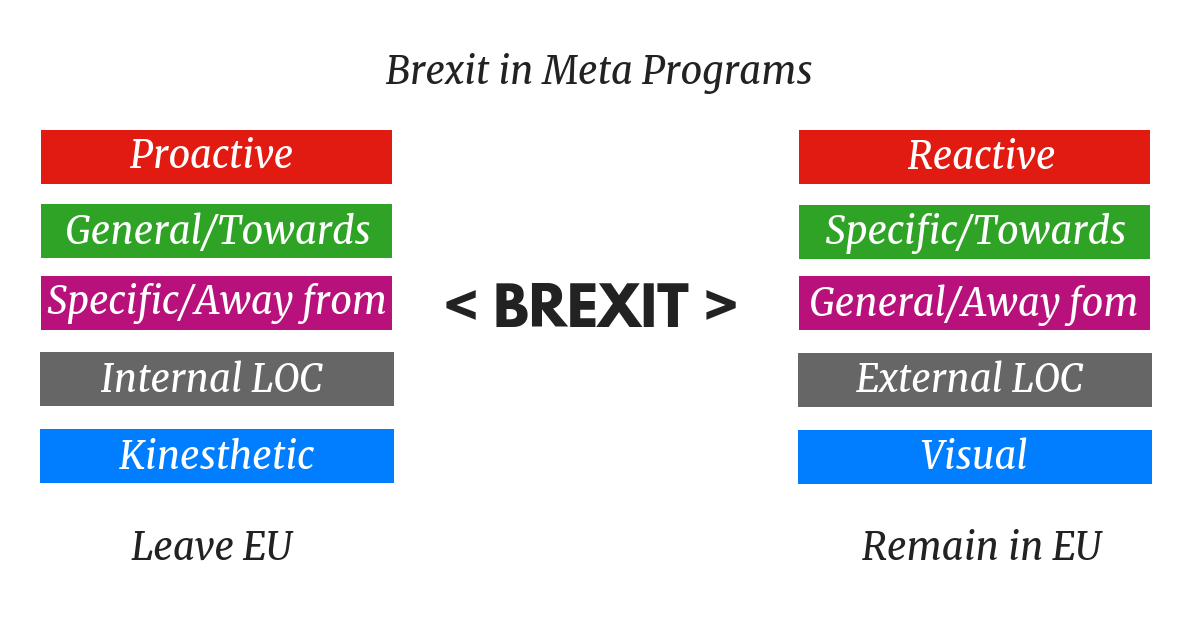
The leave camp was saying: ‘Let’s leave the EU and be great again’. The remain camp was saying: ‘Wait a minute, let’s first take a good look at all the the consequences this will have’. The remainers were responding to the leave arguments. The leave arguments were setting the scene, framing the discussion. This made the Brexiteers proactive and the remainers reactive, in the sense that they thought about what the other side was saying.

Locus of control
The leave camp was expressing internal locus of control: ‘We have the strength to shape our destiny’. Their main argument was that Britain would regain an internal locus of control that was potentially there but that has been dampened by the EU. While the remain camp took a more external locus of control position. They were saying: ‘We are part of bigger systems that we are dependent on. A lot of global developments are way outside of our control. And if we leave the EU, we’ll lose even what little control we have over that’.

We could dive into all of this more deeply, but I just want to mention one more observation and  then sum up the positions. The leave camp seemed to have more kinesthetic arguments, based on gut feelings, pride, fear, irritation. While the stay camp sounded more visual. ‘If we look at the actual numbers’, ‘If we look at the global situation’.

When I sum up the meta programs, this is the picture:

So why did the leave camp win?

  • To most people, proactive arguments (‘Lets do it!) sound better that reactive arguments (‘Wait! Let’s think about this’).
  • People are generally more motivated by general towards, broad positive goals (‘We will be great!’) than by specific towards, narrow positive goals (‘We will keep our farmer’s subsidies’). Positive goals invite a pleasant emotional state and this state tends to be stronger when the goal is painted in broader strokes.
  • Politics is a lot about locus of control. Who has the power? Politicians demonstrating internal locus of control (‘Yes we can!’) tend to be more popular than politicians showing an external locus of control (‘We are dependent on things that are bigger than us’). What the Brexiteers were basically saying is: ‘Let’s feel proud about our power to control things in the future!’ It’s a promise of future internal locus of control. Remain got the emotional benefits without the burden of responsibility. It’s the political version of ‘Buy now, pay later’: ‘Feel the power now, carry the responsibility later’.
  • People generally like simple, kinesthetic arguments (‘We are for pride, honour and the welfare of our people’) ‘rather than complicated, more visual arguments describing multiple elements and relationships (‘If we look at international law and our geopolitical position it is clear that we need to think carefully about closing our borders’).

Overseeing these thinking style differences, it is actually surprising that the leave vote wasn’t even bigger

Populist politicians
I guess the profile I sketched here, this combination of Graves drives and meta programs, is similar for most populist politicians. They claim to represent the common people and to fight the elites on the behalf of them. They are attracting large numbers of voters in most European countries. Brexit was only the beginning of a long series of right wing successes. I am afraid that the more thoughtful, informed, global view will always be more difficult to ‘sell’. It takes a greater mental effort to even understand that position.

Rob Wijnberg, a popular Dutch philosopher and journalist, has commented on this too. He notes how right wing arguments tend to sound simpler and more powerful than left wing arguments. Because the archetypal right wing argument is: ‘This is good for us, let’s do it’. Period. General, proactive, towards statements. While the left wing argument is more like: ‘There is us and then there are all these other people, and we all have our qualities and our rights, so let’s find a just and workable balance’. And also… More specific, reactive statements.

Now what?
So if we know this, then what? We can see the Brexit as a familiar clash between right wing red/orange populists and left wing blue/green reasonable politicians. Psychologically speaking the populist are unfortunately holding the better cards. Which they have had up their sleeves ever since Hitler came to power in the thirties of the last century.

If you don’t like populists, like me and most of my highly educated, cosmopolitan friends, how can you make use of this analysis? I believe that the voice of reason can be more influential than it has been recently. This voice may have  a tendency to speak in a reactive, specific, away from, visual manner, but this is no necessity. Reasonable arguments, even though they tend to be more complicated, can be presented in a proactive, general, towards and kinesthetic manner. I believe that reasonable politicians should model the populists in their thinking style and their presentation, if not their values. And understand that thinking style is not the same as thinking content. Meta programs are ways to express, handle and present your values. Blue/green values can be expressed in this format just as well.