MindSonar: The Key to Unlocking Effective Coaching Communication

Understand your client’s communication style to get better and quicker results.

As a coach, it is important to understand our client’s thought patterns and language preferences to better facilitate communication.

This is where a MindSonar profile helps us understand our clients’ cognitive styles and communication preferences.

Understand our communication style and thinking.

For us to be successful coaches, we must be self-aware of our own cognitive style and communication preferences. 

Our coaching session may be affected unintentionally by our preconceptions and preferences if we are unaware of them, which could impede the client’s progress. 

Because of this, we need to have a firm grasp of our own cognitive and communication quirks so that we can make the appropriate modifications to make the session relevant to the client’s needs.

As MindSonar is context driven, a profile specific to when we are coaching enables us to gain these insights as a coach.

 Are you of your communication style and thinking patterns as a coach?

Change our communication style for better, quicker outcomes.

Matching our language and communication style with the preferences of our clients enables us to build rapport quickly and understand their thinking and language patterns so we can ask better questions. 

Additionally, it allows us to challenge their perspectives by introducing disruptive language that may help them think differently or evolve mentally as needed. 

To illustrate, if I have a client who is a high energy, enthusiastic, and brims with positivity, I will initially mirror their communication style. Later, I may use language and questioning techniques to transition them to a more reflective and focused mode, so they avoid overlooking any potential pitfalls.

How do you change your communication style during your coaching sessions?

Change the internal communication style of my client.

Most people have some sort of inner dialogue going on in some form or another.  The language used internally has a powerful impact on an individual’s mindset and affects their behaviour and the outcomes they achieve.

Negative self-talk, ‘glass-half-empty’ and ‘away from’ thinking and language can lead to many issues for our clients around confidence, motivation, and mental health issues.  

Additionally, positive self-talk can help individuals feel more confident in achieving their goals and can help build better relationships.

Using their MindSonar profile to raise awareness of their internal thought and communication processes enables the client to transition from negative to positive self-talk quickly and easily.

Are your clients aware of how their internal communication style may be holding them back?

Changing communication changes the outcomes.

By becoming aware of their internal and external language patterns through their MindSonar profile, clients can identify when they are hindering their progress. 

Through MindSonar, clients can identify language patterns that may be inhibiting them from achieving successful outcomes. 

This newfound awareness allows for the transition into a more positive language which will inevitably spark beneficial thought processes as well as effective action plans leading to success!

Enhance your communication coaching outcomes with MindSonar.

MindSonar provides coaches with a powerful tool to better understand their clients’ communication styles and thought patterns, which leads to more effective coaching sessions and ultimately, better outcomes. 

Coaches who are self-aware of their communication preferences can also make adjustments to avoid unconsciously biasing their sessions. 

By helping clients recognise negative self-talk and transition to more positive language, MindSonar enables them to overcome mental barriers and achieve success. 

Ultimately, the ability to adjust communication styles and patterns for both coaches and clients leads to more productive and fulfilling coaching relationships and more positive and quicker outcomes.

As a coach, you want to help your clients unlock their true potential for success. 

Incorporating Mindsonar into your toolset is an excellent way to improve communication and provide more powerful coaching outcomes for your clients.

MindSonar is my go-to tool for understanding clients’ communication styles and cognitive preferences – it’s a must-have in my coaching toolkit.

Helping a Professional find their Dream Job

Sometimes talented professionals don’t fit in a given corporate culture. A common response is to doubt oneself and try to fit in. Fortunately, this professional did a MindSonar profile.

During the intake he told the MindSonar professional that he had had previous jobs that ‘fitted like a glove’. He felt happy, appreciated and was able to contribute. His last two jobs, however, had not been a great success. He felt his managers didn’t trust him and he was making a lot of mistakes. Overlooking his previous job experiences, he noticed the ‘missing ingredient’: the feeling that there was a safety net while learning.   

In his MindSonar profile he focused on a previous job when he had a 100% ‘safety net experience’. He discovered that ‘autonomy’ and ‘positive feedback’ were very important criteria for him to feel proud of his professional abilities. MindSonar helped him to understand the unique combination of meta programmes that supported his “100% safety net experience”. A combination, that immediately explained why he didn’t fit in with the present corporate culture: this was not their dominant way of thinking. 

He rewrote his resume, reconsidered his job outlook and found  an authentic way of presenting himself during job interviews (focusing on his uniqueness). He was successful: he found his dream job within a few weeks!

The MindSonar professional running this project was Jascha Kamstra (Netherlands). Look her up in the Registry.    

Mindsonar: The Key to Overcoming Internal Interference

Helping people “Get out of their own way” for business success

“Getting in our own way” is a phrase that refers to the tendency for people to sabotage their own efforts or goals through their own actions or thoughts. This can manifest in a variety of ways, such as procrastination, self-doubt, or a lack of motivation. Essentially, it means that an individual is preventing themselves from achieving something due to their own behaviour or mindset.

In “Coaching for Performance,” John Whitmore provides an inspiring formula for achieving success:

Potential – Interference = Performance.

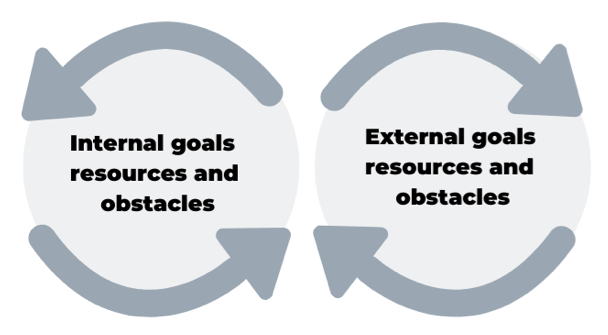
As a coach, I use this powerful principle to help clients unlock their highest potential and eliminate any barriers that can get in the way of progress and achievement. The interference, or the things that get in the way of our performance, can be both internal and external. Our individual experiences and understanding of the world are effectively shaped by our personal biases, values, and beliefs. We often process external stimuli through a filter, deleting what does not fit into our current worldview, distorting it to align with existing beliefs and values or generalising for us to better comprehend its significance.

One of the most common forms of internal interference is our own thinking. The way we think can create ripples of change in how we act or feel and ultimately realise our ambitions. We can see this from another familiar coaching tool, the cognitive Triangle.

By understanding and becoming more aware of our thinking we can influence our behaviours and manage our emotions better.

This is where the power of Mindsonar comes into play for me and my coaching, and why it is one of my go-to coaching tools. It enables me to comprehend the client’s underlying values and beliefs. This gives me a unique perspective on their worldview and the triggers that may be interfering with what they are attempting to do.

For example, when an agitated client joined a call, we used the Mindsonar methodology to uncover the core value – the underlying motivation that had been threatened by a recent interaction. With this knowledge in hand, we were able to successfully manage the situation and return to focus on achieving coaching outcomes.

The Mindsonar profile also allows me and the client to investigate, in detail, the cognitive processes that are taking place clearly and visually. It allows us to identify capabilities as well as some of the restricting thinking blind spots. Being aware of my client’s thinking style can be incredibly useful for customising a coaching experience. Take the proactive, option-oriented individual who needs more help to stay focused on their objectives rather than getting drawn in by tempting diversions. Conversely, those with a reflective and procedural cognitive style may need some extra encouragement when it comes to moving ahead at pace.

Enabling my clients to get out of their own way used to be a regular challenge for me when I started coaching. However, with Mindsonar, it’s like giving my clients a map, a compass and a flashlight to navigate through the maze of their own thoughts. They often find themselves receiving extraordinary clarity around their thought processes and any pressing issues. In many cases, it gives them the ability to get right to the heart of things.

Understanding John Whitmore’s performance formula and the importance of our cognitive style, utilising the cognitive Triangle model, demonstrates how powerful it is to have a tool that can x-ray our thinking style and gives deep insights into our cognitive preferences.

This is how I assist my customers in “getting out of their own way” and making minor but significant adjustments to their thinking, emotions and behaviours that lead to better p performance and less interference. Mindsonar opens an incredible world of possibilities in coaching, from personal transformation to developing your business.

How I use MindSonar in my Business Coaching

Understand your client’s thinking to be more effective as a coach
Who we are has a profound impact on our lives and the decisions we make. It influences not only what we do, but also how we do it when we do it (or not in a lot of cases), and most importantly, why we do it.

Our identity shapes the relationships we build with ourselves and others and determines the outcomes and results we achieve in all the roles we perform, be that in business or our personal lives.

To know thyself
Socrates famously said, ” To know thyself is the beginning of wisdom.”This simple but powerful statement highlights the importance of self-awareness and self-knowledge.. By understanding who we are, how we think and what motivates us, we can make more informed and deliberate choices about how we live our lives, run our businesses and the relationships we create.

This is why, as a Business Coach I spend time helping my clients gain clarity on how they think so they can better leverage their natural ability to “get out of their own way” and quickly achieve better results.

Cognitive style
One aspect of who we are is the way we think – our cognitive style. Cognitive styles are ways that people absorb and organise information as well as how they go about solving problems and making decisions and communicating them with others. As an experienced coach, I am constantly and creatively combining different methods andtools to create unique strategies for my clients. Seeking out new approaches is the best way to ensure that every individual reaches their desired outcomes! That’s why I’m a big fan of Mindsonar.Tailoring my coaching to each clientMindsonar is a tool that measures two things: your thinking style and what is important to you. This information is invaluable in helping me tailor my coaching to each client. By understanding how my client thinks, I can better understand how to best help them change their thinking and behaviours and enable them to be more themselves.

Moreover, by understanding what is important to them and their cognitive style, I can be more effective as a coach in the way I communicate, challenge, and support them during our coaching sessions. I can help them create goals and action plans that are aligned with their values and how they naturally think.

What will work for them and who they are?
There’s no one-size fits all blueprint when it comes to success – individual approaches must reflect a person’s unique abilities and methods of thinking to be effective.Therefore, using the Mindsonar tool I can Identify the unique combination of methods that will work for them and who they are.In short, Mindsonar is a powerful tool that can help coaches facilitate real change in their clients, fast. By enabling our clients an understanding who they are and how they think they can better leverage their unique talents and abilities and be more effective and efficient in achieving their objectives.

As a coach, you want to help your clients unlock their true potential for success.Incorporating Mindsonar into your toolset is an excellent way to give them the edge they deserve. Unlocking greater understanding and clarity in just minutes – what could be better?

Amplifying your Team’s Advantages (Financial Industry)

AMPLIFYING YOUR TEAM’S ADVANTAGES

Understanding diversity in the financial industry and making it work for you

Financial institutions are pillars of society, secure and reliable institutions that take care of money transactions. Of course, the foundations of financial institutions are their employees, and these types of companies are extremely careful about who they recruit to positions within their organisations.

When we talk about financial institutions we are most familiar with banks, as we do business with banks almost on a daily basis. In doing so, we meet mostly with their sales departments. Far fewer people understand what else is needed in a bank’s inventory to perform safely and reliably. Hence banks employ a wide range of different team members who need appropriate qualifications in order to perform their work well. Staff members are provided with constant training, as banks are continuously evolving to offer their clients the most advanced and reliable services. As a business coach, I have worked with several banks operating in international markets and have trained heads of various departments, giving me the opportunity to recognise different ways of working, different ways of communicating and, of course, different thinking styles.

In my work, I use one of the best performing and effective profiling tools – MindSonar® – which allows professionals to identify their own ways of thinking and their most likely responses in specific situations. In this way, they are enabled to gain self-knowledge and to recruit team members who have different ways of thinking in specific contexts, which leads to creativity and the ability to solve even the most demanding challenges. Of course, an added benefit of knowing each other in this way is that they can more often avoid conflicts and resolve problems.

It is also true that understanding the diversity of team members gives the organisation, its leaders, teams and individual employees the responsibility to develop and strengthen their competences and thus enable each other to achieve the highest level of efficiency in communication, relationships and operations, provided, of course, that they are also suitably professionally competent.

We have recently prepared and delivered workshops with an HR department of a banking organisation.  The workshops are intended to strengthen communication and relational skills and raise emotional intelligence.  Analysis of a team’s MindSonar® group profile demonstrated a strong pattern of how individuals, specifically in the positions of sales managers, are similar in thinking styles in specific contexts. This is of course, logical, as a position of a branch manager or a sales manager requires a certain approach, and therefore, it makes sense for the organisation to either recruit or develop a co-worker who will cope with the challenges this position brings. At the same time, we discussed with these leaders how they value different thinking patterns in their teams. Despite relationships that sometimes require more input, it is precisely different patterns of thinking that strengthen and enrich a team, especially in the sense that it can achieve above-average efficiency and when it comes to financial management, appropriate returns.

Recognition that professionals need high-level communication and relational skills for their optimal functioning is crucial for both the development of the individual as well as the organisation. In identifying this, financial institutions, as the most technologically and security-wise advanced companies, are at the forefront of modern corporate operations.

An effective and widely useful tool enabling the profiling of diversity of thinking styles – MindSonar® enables identifying differences in thinking and facilitates guiding the development of individuals. Using MindSonar® means skilled trainers and profiling practitioners – MindSonar® Professionals – can assess individuals or entire teams and show them where and how they can progress, accessing coaching and specialised workshops. Organisations and teams can develop optimally and achieve maximum prosperity.

Ob-la-di, ob-la-da! Happiness is Something you can Model!

Happiness Is Something You Can Model!

In the multitude of conversations I have with candidates with a work or life questions,

dilemmas in their careers, difficulties around absenteeism and illness or managers who struggle with keeping their team on track in times of Corona, it was great to talk to someone who said with a sparkle in their eyes: “Yes, I am always very happy!”

I decided not to ask the famous NLP (meta model) question “always?” I let her continue: “My basic feeling is always a number 8 or higher. Everything will be fine and I will make sure of that.”

I looked at her almost breathlessly, jumped from my chair, grabbed the MindSonar mug and poured her another cup of tea. “I’m going to take a test with you because so many people will want learn this from you!” She looked at me in surprise and continued: “I’m just naturally happy with the situation as it is and then I make something great out of it.”

You’ll understand that I was very curious about her profile . As context we chose: “Being especially happy”. Here is, in broad strokes, what I found.

Her meta-criterion turned out to be “Fulfilment”. A word I don’t see coming by that often as a meta criterion. Wouldn’t it be nice to have all those meta criteria from all MindSonars taken so far in one big word cloud (because you don’t have enough on your plate, Jaap).

The Sonar diagram contained Matching (8.8!), Present (7.4), Internal reference (7.4) and Towards (8.5).

Also notable were Kinesthetic (almost 7) and People (almost 5). And even scores across

maintenance, development and change and also balance in concept, structure, use.

Every time I Frankenstein this (‘Frankensteining’ = stepping into combinations of meta programs), I immediately feel good myself! I’m in the here-and-now, I feel

fulfilled, I’m doing it together with people, I know pretty much what I want and I have influence on that too. It doesn’t have to happen very fast, I can reflect and work out some details and roadmaps.

Plus: I rarely look at what is wrong in my life.

Amazing what MindSonar can teach us. You could almost sing it out loud!

Happy ever after in the market placeDesmond lets the children lend a handMolly stays at home and does her pretty faceAnd in the evening she still sings it with the band